
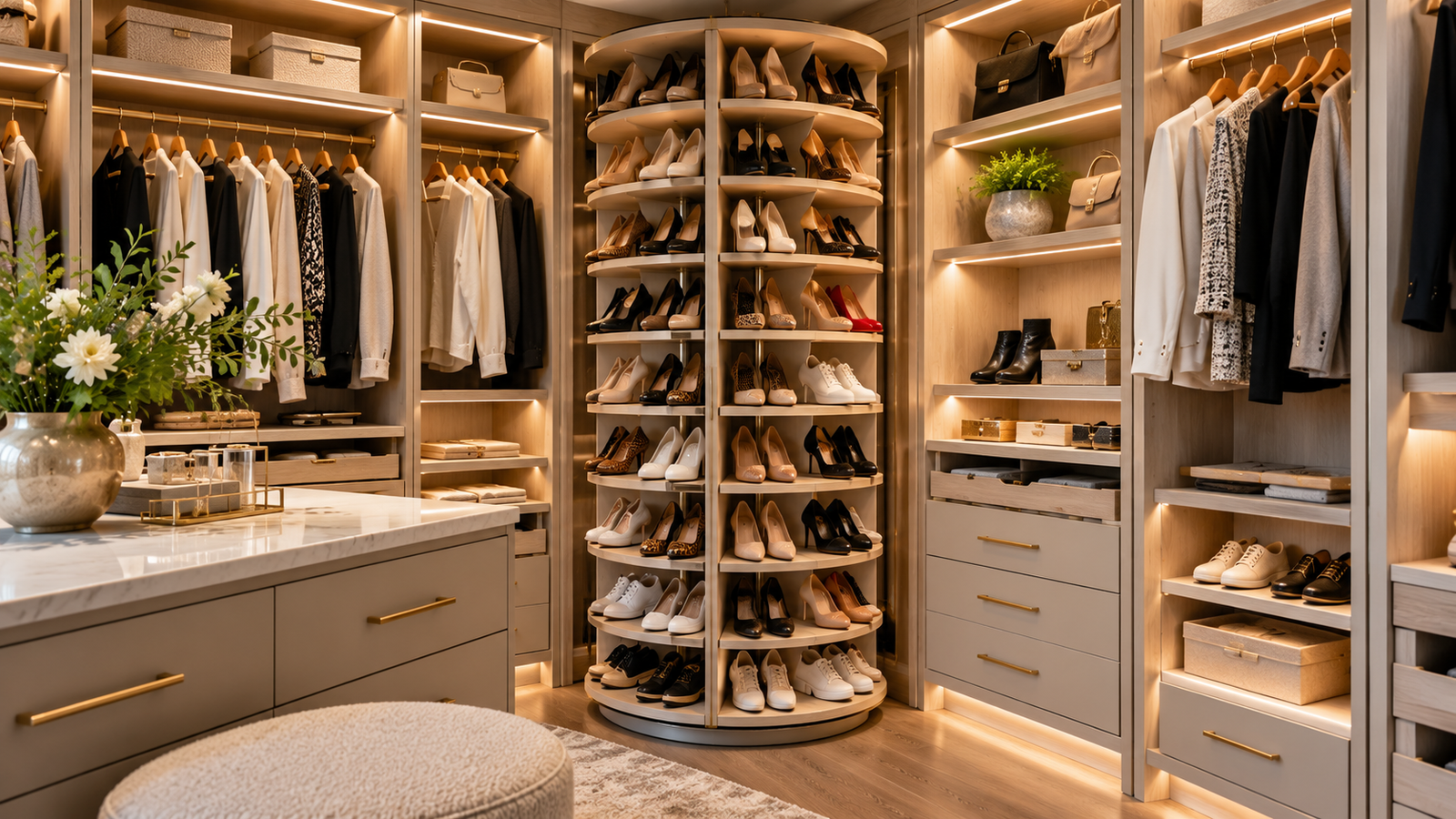
A growing shoe collection can quickly take over closet shelves, bedroom floors, and entryway storage. Traditional shoe racks work well for smaller collections, but they can become difficult to manage when you own dozens of pairs or want to make better use of your closet’s available space.
Rotating shoe storage offers a different approach. Instead of arranging every pair along a fixed shelf, a rotating shoe organizer brings different sections of your collection into view as the unit turns. This design can be particularly useful in custom walk-in closets where corner space is difficult to use efficiently.
But is a shoe spinner worth the investment? The answer depends on your shoe collection, closet layout, available clearance, and organizational priorities.
In this guide, we’ll explain how rotating shoe storage works, compare it with traditional shoe racks, explore its advantages and limitations, and help you determine whether it belongs in your custom closet design.
What Is Rotating Shoe Storage?
Rotating shoe storage is a storage system designed to hold multiple pairs of shoes on a structure that turns to provide access to different sections. Depending on the design, the system may rotate around a central axis, allowing you to reach shoes that would otherwise be difficult to see or access.
Unlike a conventional shoe rack, which presents a fixed row of shelves, a shoe spinner organizes footwear vertically and makes multiple storage sections accessible through rotation.
Some rotating systems are freestanding, while others are designed to integrate into a custom closet. Built-in models can be planned around the room’s dimensions, existing cabinetry, and the size of the shoe collection.
For example → Nova Closet offers a Revolver Shoe Spinner Unit designed to use otherwise underutilized closet corners. Its system rotates manually through 360 degrees and can accommodate up to 200 pairs in an appropriate configuration. Actual capacity depends on the unit’s dimensions, shelf spacing, and the footwear being stored.
You can explore the Nova Closet Revolver Units page to see how rotating storage can be incorporated into a custom closet.
How Does a Shoe Spinner Work?
A rotating shoe organizer uses a central support and a series of storage surfaces arranged around it. Turning the unit brings different sections toward the user, making it possible to access footwear without moving several pairs out of the way.
The exact mechanism and layout depend on the model.
1. Vertical storage
Instead of spreading shoes across multiple walls or floor-level racks, a spinner uses vertical space. This can help keep the closet floor clearer while creating a dedicated location for a larger collection.
2. Rotating access
The unit turns so you can reach shoes stored around its structure. Rather than walking around a large fixed display or reaching deep into a corner, you rotate the organizer to bring the desired section closer.
3. Multiple storage levels
Different shelves can accommodate different types of footwear. Sneakers, flats, sandals, and many everyday shoes may fit on standard shelves, while boots and taller shoes may require additional vertical clearance.
4. Integration with closet cabinetry
A custom rotating unit can be planned alongside hanging sections, drawers, shelves, and other closet accessories. This creates a coordinated storage layout instead of treating shoe organization as a separate project.
Rotating Shoe Storage vs. Traditional Shoe Racks
Both storage options can work well. The better choice depends on how many shoes you own and how your closet is arranged.
| Feature | Rotating shoe storage | Traditional shoe rack |
|---|---|---|
| Access | Rotates to bring different sections forward | Shoes remain in fixed positions |
| Use of corners | Can make selected corners more functional | May leave difficult corners unused |
| Capacity | Potentially high in a purpose-designed unit | Depends on rack width, height, and shelf count |
| Installation | Built-in systems require careful planning | Many models are freestanding |
| Flexibility | Depends on the design and installation | Freestanding racks are often easier to move |
| Best suited for | Larger collections and custom closet layouts | Small to medium collections and simple storage needs |
A rotating organizer is not automatically better than a conventional rack. If you own ten pairs of shoes and have a convenient shelf, a simple rack may be all you need.
However, if your collection is growing, your closet has an awkward corner, or you want a more integrated storage solution, a shoe spinner may offer meaningful advantages.
7 Benefits of Rotating Shoe Storage
1. Makes Better Use of Closet Corners
Corners can be challenging to design around. Fixed shelves may leave part of the storage area difficult to reach, particularly when cabinetry turns around a wall.
A rotating shoe unit can make that space more functional by bringing different sections forward as it turns.
This is especially worth considering in a walk-in closet where a corner might otherwise become a low-priority storage area.
2. Keeps a Large Shoe Collection Organized
When footwear accumulates, shoes can end up in boxes, on the floor, or behind other pairs. A dedicated rotating system creates a defined location for the collection.
You can organize shoes by type, season, color, or frequency of use. Everyday footwear can occupy convenient sections, while occasional and formal shoes can be stored in other areas.
3. Makes Shoes Easier to See
Shoes stored deep on fixed shelves may become difficult to identify, especially when several pairs look similar.
Rotating storage can make different sections easier to inspect. You can bring the relevant area forward instead of repeatedly moving neighboring shoes.
The practical benefit depends on shelf spacing, lighting, and how consistently the collection is organized.
4. Uses Vertical Space
Floor space is valuable in a closet. Tall storage systems can move footwear off the floor and consolidate it into a dedicated vertical area.
This can help maintain a cleaner appearance and leave more room for walking, dressing, and accessing other parts of the closet.
Before choosing a tall unit, consider ceiling height, access to upper shelves, and the types of shoes you need to store.
5. Can Be Integrated Into a Custom Closet
A built-in shoe spinner can be designed to complement the rest of the closet’s cabinetry.
Finishes, adjacent shelves, hanging sections, and drawers can be coordinated so the unit feels like part of the overall design.
For a broader look at integrated storage options, explore Nova Closet’s custom closet accessories.
6. Creates Space for More Than Shoes
Some rotating systems include additional shelving that can accommodate selected accessories, handbags, or folded clothing.
The suitability of these areas depends on the unit’s design and the dimensions of the items being stored. Heavy or oversized belongings should only be placed on shelves intended to support them.
7. Supports a More Personalized Storage Plan
A shoe spinner can be designed around an individual’s collection rather than a generic set of shelves.
For example, a household with many sneakers may need a different shelf arrangement from someone with a collection of heels, boots, and formal footwear.
Planning the system around real storage needs helps prevent wasted space and makes the finished closet easier to use.
Is a Rotating Shoe Organizer Right for a Small Closet?
It can be, but available floor area alone does not determine whether a rotating unit will work.
A compact closet must have enough depth and clearance for the selected unit to turn without interfering with doors, drawers, hanging clothes, or nearby walkways.
Before choosing a shoe spinner for a small closet, evaluate the following:
-
- Corner depth: Is there enough space for the complete unit?
- Rotation clearance: Can it turn without hitting adjacent cabinetry or doors?
- Ceiling height: Can the unit use vertical space without making upper shelves impractical?
- Collection size: Will the available capacity justify the space the unit occupies?
- Access: Can you comfortably reach the shoes on every section?
In some small reach-in closets, conventional pull-out shoe shelves or adjustable racks may be more practical. In other layouts, a carefully planned rotating unit can make an otherwise awkward corner useful.
The best solution is the one that works with the actual room dimensions, not simply the one with the largest advertised capacity.
What Types of Shoes Can You Store?
A rotating shoe organizer can accommodate many footwear types, but the shelf layout matters.
Sneakers and everyday shoes
These are often straightforward to store because many pairs have similar dimensions. Consistent shelf spacing can help keep the collection visible and orderly.
High heels and dress shoes
Heels may need a different arrangement from sneakers. Consider shelf depth, spacing, and how the shoes will rest on the storage surface.
Sandals and flats
These typically require less vertical clearance, potentially allowing more efficient use of selected shelves.
Boots and taller footwear
Boots need additional height and may not fit on every level of a rotating system. Tall boots should be planned for specifically rather than assuming that all shelves can accommodate them.
Handbags and accessories
Some systems offer extra shelves suitable for selected handbags or folded items. Keep heavier belongings within the unit’s intended load limits and avoid overcrowding the rotating sections.
What to Consider Before Installing a Shoe Spinner
A rotating storage unit should be selected based on practical requirements, not capacity alone.
Measure the closet accurately
Measure the available width, depth, and height. Identify door openings, trim, baseboards, nearby drawers, and any other features that could affect installation or rotation.
A custom design should account for these constraints before fabrication begins.
Count your shoes
Estimate how many pairs you currently own and how your collection may change over time. Include larger footwear that needs more space per pair.
Do not assume that a maximum advertised capacity will match your collection. Actual capacity depends on the design and the size of the shoes.
Consider access and visibility
Think about which shoes you use most frequently. Your preferred organization method should make everyday footwear easy to reach without requiring unnecessary movement or rearrangement.
Evaluate construction and movement
Ask how the unit rotates, what materials are used, and how the system will be installed. For a built-in organizer, the design should be checked for smooth movement and suitable clearances.
A manual rotating unit does not require a motor, but its construction and installation still matter.
Coordinate the unit with the rest of the closet
A shoe spinner should complement the hanging areas, drawers, shelves, and walking space. The design should make the entire closet more functional rather than maximizing shoe capacity at the expense of everything else.
How Much Does Rotating Shoe Storage Cost?
The cost of rotating shoe storage varies by system, dimensions, materials, finish, and installation requirements.
A standalone organizer and a custom-built unit integrated into a larger closet are different types of projects, so their prices may not be directly comparable.
When requesting a quote, consider:
» The size and configuration of the rotating unit
» The number and spacing of shelves
» The materials and finish
» Whether additional storage features are included
» Whether the unit is part of a larger custom closet
» Measurement, design, fabrication, and installation requirements
Rather than choosing solely by the number of pairs a system can hold, compare how effectively it uses your available space and meets your day-to-day needs.
For a built-in solution, a professional design consultation can help establish the appropriate dimensions and overall project cost.
Rotating Shoe Storage Design Ideas
The right layout depends on the room, the collection, and the way you use your closet.
For a large walk-in closet: Consider positioning the rotating shoe unit in a corner while keeping frequently worn clothing and accessories within easy reach.
For a closet with an unused corner: Explore whether a rotating system can turn a difficult-to-access area into dedicated shoe storage.
For a collection with different footwear types: Plan shelf spacing around sneakers, heels, sandals, and boots instead of using identical spacing everywhere.
For a coordinated luxury closet: Match the rotating unit’s finish with the surrounding cabinetry and combine it with appropriate lighting and complementary accessories.
For a compact closet: Compare a rotating system with pull-out shelves before committing to a layout. The better option will depend on clearance and how much storage you actually need.
Final Thoughts: Choosing the Right Shoe Storage System
Rotating shoe storage can be a smart option for homeowners who want to organize a large collection, use closet corners more effectively, and integrate footwear storage into a custom-designed space.
Its value depends on the relationship between capacity, accessibility, installation requirements, and the room’s layout. A well-planned shoe spinner should make your collection easier to manage without compromising the rest of the closet.
If you are considering a custom shoe storage solution, start by evaluating your collection, measuring the available space, and comparing rotating storage with conventional shelves.
Nova Closet offers custom storage solutions, including its Revolver Shoe Spinner Unit, for homeowners across Northern Virginia, Maryland, and Washington, D.C. Explore the Revolver Units page to learn more, or schedule a consultation to discuss a layout designed around your space and collection.
Frequently Asked Questions
Is rotating shoe storage worth it?
It can be worthwhile if you have a large shoe collection, an underused closet corner, or a preference for integrated storage. For smaller collections, a traditional rack may be more affordable and practical.
How many pairs can a rotating shoe organizer hold?
Capacity varies considerably by design. Nova Closet’s Revolver Shoe Spinner Unit is designed to hold up to 200 pairs in an appropriate configuration. The actual number depends on unit dimensions, shelf spacing, and footwear sizes.
Does a shoe spinner need electricity?
Not every rotating shoe organizer is motorized. Nova Closet’s Revolver Shoe Spinner Unit rotates manually, so it does not require an electric motor.
Can a rotating shoe unit fit into a reach-in closet?
Potentially, provided the closet has sufficient depth and clearance. Measurements and the unit’s rotation path should be checked before the design is finalized.
Can I store boots and handbags in a shoe spinner?
Some designs offer flexible shelving that can accommodate selected boots, handbags, and other items. However, shelf height, depth, and load capacity determine what can be stored safely and conveniently.
Is a rotating shoe organizer better than pull-out shoe shelves?
Neither option is universally better. A rotating unit may suit a large collection and an underused corner, while pull-out shelves may be easier to incorporate into a narrow or shallow closet. Compare the available space and your storage priorities before deciding.