
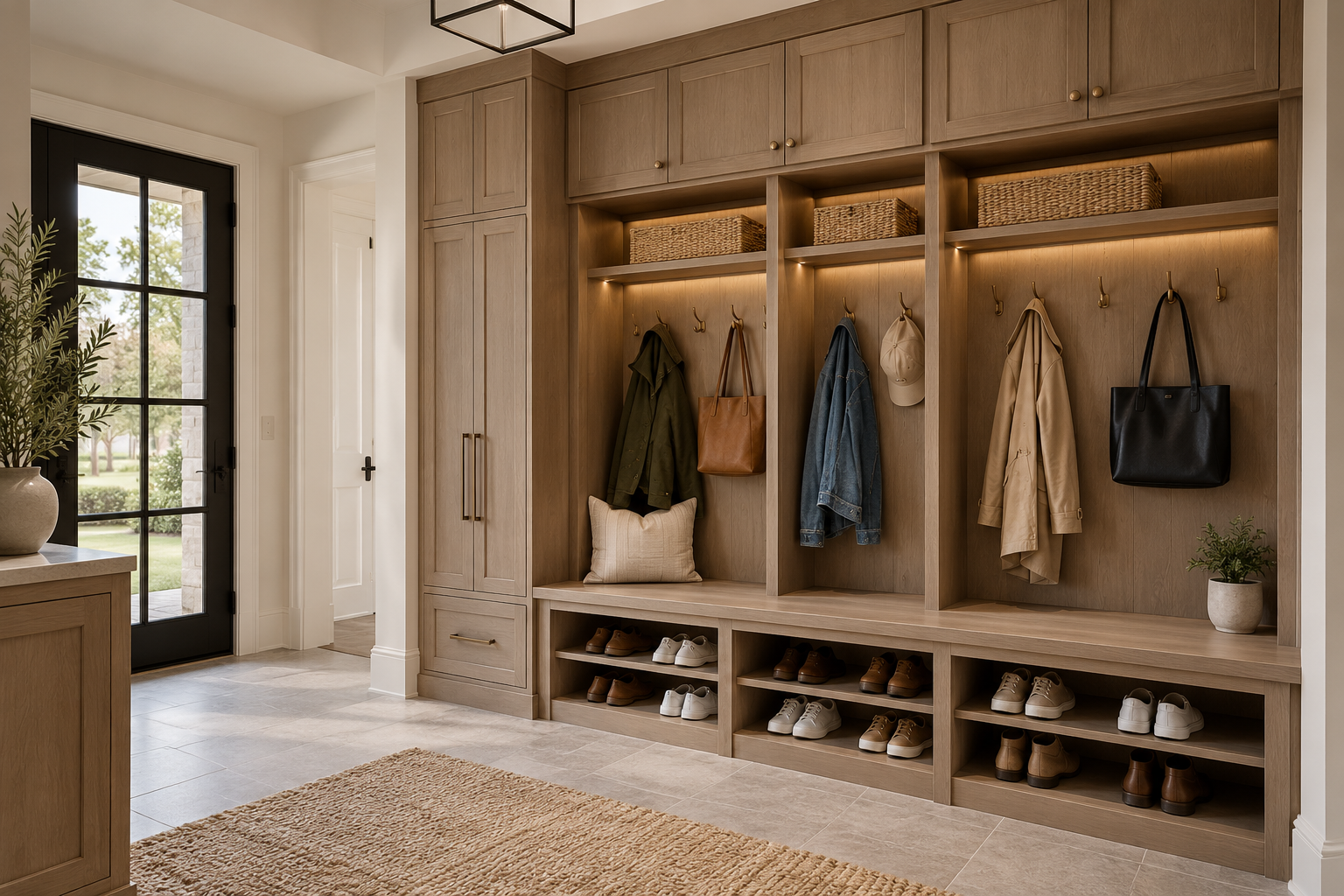
Most mudroom ideas you see online solve the wrong problem. They show a pretty bench, a row of hooks and three baskets, photographed on a dry day with nobody home.
Real mudrooms fail on a Tuesday in February, when four people come through the door at once with wet boots, a backpack, a lacrosse stick and a dog on a leash.
A mudroom works when every item that comes through the door has a place to go within two steps of the door, and every person knows which place is theirs.
That is a design problem, not a decorating one. It comes down to layout, a handful of measurements and materials that can take water and weight.
This guide covers all three. It also covers the more common situation in Northern Virginia, Maryland and D.C. homes: you do not have a mudroom at all, only a hallway, a garage entry or a wall beside the back door.
Mudroom Layouts: Start With the Door, Not the Furniture
The first question is not what style you want. It is which door your household actually uses. In most DMV homes built after 1980, that is the garage door, not the front door. Design for the door people use every day and the rest follows.
The full mudroom
A dedicated room of 6 by 8 feet or more, usually between the garage and the kitchen. You have room for lockers on one wall, a bench and closed storage on another, and often a utility sink or a pet station. The risk with a full room is overbuilding: too many open cubbies become too many places for clutter to collect.
The garage entry
The most common mudroom we design. The lockers go on the garage side of the house door or on the wall just inside it. On the garage side, you gain space and keep the mess out of the house entirely, but the boxes must handle temperature swings and humidity. Pair the lockers with garage cabinets on the same wall and the whole entry reads as one built-in.
The hallway mudroom
A back hall or side entry of 42 inches or wider can take a shallow run of lockers, a bench or both. Here, depth is everything: every inch you add to the cabinets comes out of the walkway. A 15-inch-deep locker and a 36-inch clear path is a better hallway than an 18-inch locker that people turn sideways to pass.
The single-wall drop zone
No hall, no room, just 4 to 8 feet of wall near the door. This still counts as a mudroom if it is designed. A bench with shoe storage below, a hook rail above and a closed cabinet at the top will hold most of what a family of four brings in. Many of our installs in D.C. rowhouses and Fairfax townhomes are exactly this.
Mudroom Dimensions: The Measurements That Decide Whether It Works
Most mudrooms that fail were built a few inches wrong. A bench that is too deep becomes a shelf for bags. Hooks that are too high mean kids drop coats on the floor. Use these as starting points, then adjust for your household.
| Element | Recommended size | Why it matters |
|---|---|---|
| Bench seat height | 17 – 19 in | Comfortable for pulling on boots; matches a standard chair |
| Bench depth | 15 – 18 in | Deep enough to sit, shallow enough not to become storage |
| Locker width (per person) | 15 – 24 in | 18 in fits most adults; 24 in for sports gear or winter coats |
| Locker depth | 15 – 20 in | 15 in in hallways; 18 – 20 in when coats hang facing out |
| Adult hook height | 60 – 66 in | Keeps long coats off the bench |
| Kids’ hook height | 36 – 48 in | Low enough to reach, so coats land on hooks, not floors |
| Shoe cubby height | 7 – 9 in sneakers; 14 – 18 in boots | One boot cubby per person prevents the pile |
| Upper cabinet top | 84 – 96 in | Seasonal gear lives above reach, out of sight |
| Clear walkway | 36 in minimum; 42 – 48 in ideal | Two people can pass with bags in hand |
Two checks before anything is built. First, map the door swing, including the garage door’s interior swing and any storm door. Second, count the people and the pets, then add one spare bay for guests and the growth nobody plans for.
9 Mudroom Ideas That Hold Up to Real Life
- Give every person a locker. Assigned bays are the single biggest fix. When a child knows the third locker is theirs, the backpack has an address. Label them, or let finish color do the work.
- Build the bench with storage under it. An open shoe shelf or pull-out bins under the seat keeps the floor clear. Leave a 4-inch toe-kick so wet shoes can dry without touching the cabinet face.
- Mix open and closed storage. Open cubbies are fast; closed doors hide clutter. A good ratio is open at hand height for daily items and closed above for seasonal gear. A wall of only open cubbies will always look messy.
- Add a drop zone for small things. Keys, mail, sunglasses and dog bags need a shallow drawer or a 12-inch counter, not a hook. Without one, those items migrate to the kitchen island.
- Put a charging drawer in the drop zone. A drawer with a built-in power strip ends the cable tangle on the counter and makes sure phones leave the house charged.
- Plan for boots, not just shoes. Winter boots need 14 to 18 inches of height. A boot tray or a slatted shelf lets snowmelt drain instead of pooling. See our guide to shoe and accessory storage for more options.
- Use a mix of hook types. Cast-steel double hooks for coats and bags, cleat or slat-wall hooks for leashes, helmets and sports gear. Our mudroom accessories are specified with the lockers so the hardware matches.
- Make room for the dog. A low cubby for a bed, a hook for the leash and a drawer for treats and towels. Pet owners often call this the most-used part of the mudroom.
- Combine it with the laundry room. If the washer is near the entry, a shared wall for lockers and a folding counter lets dirty clothes go straight into the wash. Our laundry room design guide covers the measurements.
Materials That Survive a Wet Virginia Winter
A mudroom takes more abuse than any closet in the house. Wet coats, salt, sand, cleats, dog claws and kids sitting on the bench to kick off boots. Materials matter more here than anywhere else.
- Furniture-grade ¾-inch TFL. Thermally fused laminate resists moisture and wipes clean. Thinner board sags under heavy bags; ¾-inch holds a loaded shelf without bowing.
- Sealed edges. Edge banding on every exposed edge stops water from wicking into the core, which is how cheap mudroom units swell and peel.
- Durable bench tops. A laminate or solid-surface seat handles daily wear far better than a painted top. Add a cushion only if the cover is removable and washable.
- Matte or textured finishes. Wood-grain and textured laminates hide scuffs and fingerprints better than high-gloss white. Our doors and finishes library offers more than 50 options, so the lockers can match the closets.
- Metal hooks, not plastic. Cast steel holds a wet winter coat and a full backpack without bending or chewing up fabric.
5 Mudroom Mistakes to Avoid
- Too many open cubbies. Every open square becomes a place to stash something. Close at least a third of the storage.
- A bench that is too deep. Over 18 inches, it becomes a shelf. Bags go on the seat and nobody can sit.
- Hooks without a backer. Hooks screwed into drywall pull out. Mount them to a rail or locker back built for the load.
- Forgetting the floor. Even the best cabinets look bad above a soaked rug. Plan a boot tray or porcelain tile and a washable mat.
- Designing for today. Toddlers become teenagers with sports bags. Adjustable shelves and hook rails let the mudroom grow with the family.
How Much Does a Custom Mudroom Cost?
Cost follows four things: the number of lockers, whether there is a bench, how much closed cabinetry goes above, and the finish. A single-wall drop zone with a bench and a hook rail is one of the most affordable built-ins we make.
A full room of lockers with upper cabinets, a drop-zone counter and a charging drawer costs more, but it is still usually installed in one to two days.
The fastest way to a real number is a free consultation. A designer measures your entry in person or online, shows you a 3D model and gives you a price before anything is cut, so you control the budget in the design. Nova also offers a price match guarantee and a limited lifetime warranty.
Design a Mudroom That Fits Your Entry
The best mudroom ideas are the ones built around your door, your family and your winter. Nova Closet designs every mudroom in 3D, builds it in our own millwork shop in Chantilly, Virginia, and installs it with our own team across Northern Virginia, Maryland and Washington, D.C.
See the custom mudrooms we build, visit the showroom at 14000 Thunderbolt Pl, Ste K, Chantilly, VA 20151, or call 703 691 5195. Then book a free design consultation, in-home or virtual, and have your entry ready before the first snow.
Mudroom Ideas FAQ
What should a mudroom have?
At minimum: a place to sit, hooks for coats and bags, shoe and boot storage, and a drop zone for keys and mail. Lockers per person and closed cabinets above make it work long-term.
How big does a mudroom need to be?
Not big. A 4-foot wall can hold a bench, hooks and shoe storage for two people. A 6- to 8-foot wall fits lockers for a family of four. A dedicated room starts around 6 by 8 feet.
What are good small mudroom ideas?
Go vertical. Use a shallow 15-inch bench, a hook rail at two heights, closed cabinets to the ceiling and a wall-mounted drop-zone shelf. Skip the open cubbies in tight spaces.
Can I put a mudroom in my garage?
Yes. A garage-side mudroom keeps dirt out of the house entirely. Use moisture-resistant boxes, keep the bench off the slab, and plan around the house door swing.
How long does a custom mudroom take to install?
At Nova, most mudrooms install in one to two days once fabrication in our Chantilly shop is complete.